


The Lake X Observation Tower: Mercury History Under Restoration!
.JPG/v1/fill/w_320,h_320/file.jpg)
For generations of Mercury enthusiasts, few places have carried the same mystique as Lake X. Isolated, difficult to reach, and surrounded by Florida wilderness, it was the perfect place for Mercury founder Carl Kiekhaefer to test engines, propellers, gearcases, and race boats far from competitors.
He simply called the undisclosed location Lake X. Officially known as Lake Conlin, the remote Central Florida lake near St. Cloud became Mercury’s secret warm-weather proving ground in the late 1950s. The roughly 1,400-acre lake offered the privacy Kiekhaefer demanded, and the mysterious name “Lake X” quickly entered Mercury folklore.
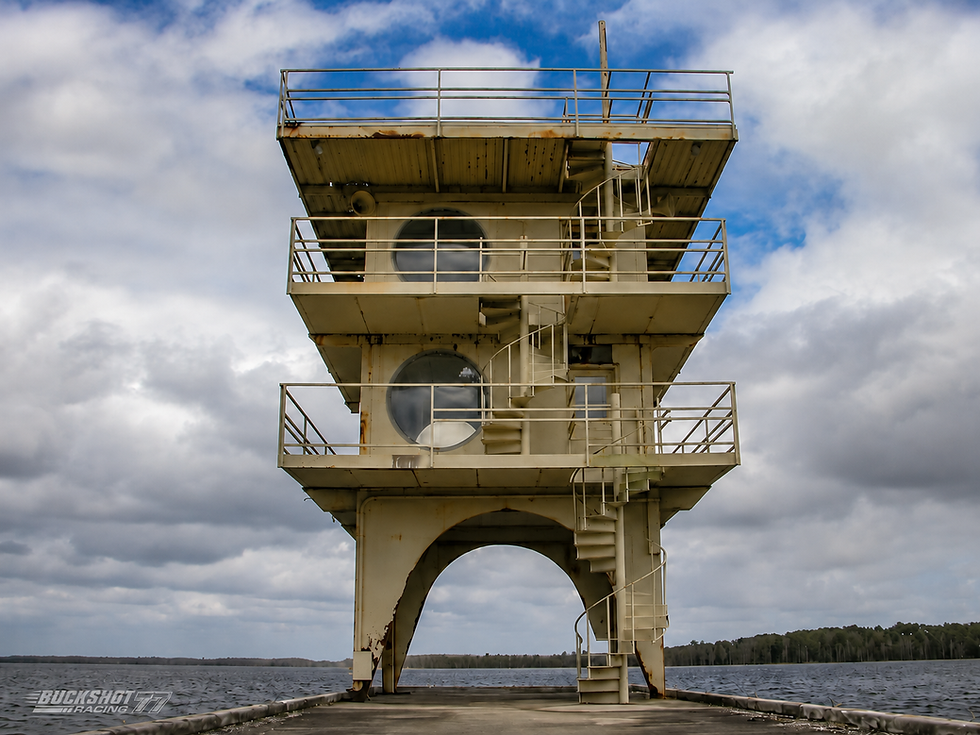
At the end of the concrete pier stood one of the most recognizable structures in Mercury history: the multi-level Lake X observation and timing tower. With its large round windows, wraparound railings, and distinctive stacked design, it looked almost futuristic. More importantly, it was a working tool. Engineers and observers used it to time laps, monitor test runs, and watch boats being pushed to their limits.
Today, that landmark is being refurbished. Recent work on the structure marks an important effort to preserve one of the most recognizable pieces of Mercury performance history.
Operation Atlas and the Birth of the Lake X Legend
In 1958, Mercury launched Operation Atlas, one of the most ambitious endurance demonstrations ever attempted with an outboard. Two boats powered by 70 HP Mercury Mark 75 inline-six engines ran continuously around the lake, day and night, with the goal of covering roughly 25,000 miles — approximately the circumference of the Earth.
The test lasted more than 34 days. Drivers were changed while the boats were underway, fuel was transferred on the fly, and the engines accumulated hours with almost no interruption. Personnel in the observation tower timed every lap and watched the boats as they passed.
The leading boat ultimately completed more than 25,000 miles. Combined, the two boats accumulated roughly 50,000 miles of continuous running. Operation Atlas helped cement Mercury’s reputation for durability and turned Lake X into one of the most important proving grounds in marine engineering.
From Endurance Testing to Mercury Racing Development
Operation Atlas was only the beginning. Over the following decades, Lake X became a critical development center for Mercury Marine, Mercury Hi-Performance, and later Mercury Racing. Engines, propellers, gear ratios, hull setups, drive heights, ignition systems, and complete race-boat packages could be changed, tested, and compared in rapid succession.
Fred Kiekhaefer later recalled that the facility kept technicians, tools, propellers, gear ratios, and drive-height hardware ready at all times. He also noted that Mercury’s first V6 outboards, the first MerCruiser sterndrives, and numerous Mercury racing engines were tested at Lake X.
From the tower’s round windows, engineers watched the transition from Mercury’s legendary inline-six engines into the V6 era that produced the familiar 2.0L, 2.4L, 2.5L, and 3.0L families. Those engines went on to power everything from fishing boats and bass boats to offshore performance hulls, tunnel boats, drag boats, and purpose-built Formula race boats.
The development culture behind engines such as the Bridgeport, Pro Max, 245 Carb, 260 EFI, 280 ROS, S3000, and 300 Drag was built on repeated testing, careful observation, and constant refinement. Lake X was one of the places where that process happened. Some boats left carrying the coveted “Dialed In at Lake X” decal — a quiet badge of serious Mercury performance pedigree.
Ownership, Conservation, and Mercury’s Return
In 1984, the Lake X property and surrounding land were sold to Kenneth Kirchman, who established the area as a large nature preserve under the Kenneth Kirchman Foundation. The property includes more than 10,000 acres, and the foundation’s mission focuses on conservation, wildlife habitat, longleaf pine restoration, and ecology education.
Mercury continued using the core test facility under lease for many years before leaving its original Lake X operation around 2003–2004. The relationship was not permanently severed. Around 2017–2018, Mercury returned under a new long-term lease and again began using Lake X for testing, research and development, boat-builder evaluation, and occasional product and media events.
Today the conservation foundation owns the property while Mercury leases the portions needed for marine testing. Lake X remains both a protected natural area and an active engineering site.
The Tower’s Refurbishment
By the early 2000s the observation tower had already endured decades of Florida heat, humidity, storms, and corrosion. When Scream and Fly documented Mercury’s final days at the original Lake X operation in 2003, the structure was already considered unsafe to climb. Later photographs showed significant deterioration.
Rather than allowing the landmark to disappear, recent efforts have focused on refurbishing the tower. The work aims to stabilize and preserve the structure so that one of Mercury’s most recognizable symbols can continue standing on the pier where so much history was made.
Modern marine testing no longer depends on an elevated manned tower the way it did in the 1950s through the 1970s. GPS, digital engine management, onboard sensors, remote cameras, drones, and sophisticated data systems now record far more information with greater precision.
In its day, however, the tower was an essential instrument. A measured course, a stopwatch, trained observers, and those distinctive round windows were once critical tools of marine engineering.
What the Tower Has Seen
The Lake X tower watched some of the most important periods in Mercury history. It stood over Operation Atlas and the Mark 75 endurance runs. It was present for the testing of Mercury’s first V6 outboards and the first MerCruiser sterndrives. It witnessed the rise of the 2.0L, 2.4L, 2.5L, and 3.0L racing platforms, countless propeller tests, engine-height changes, gear-ratio experiments, endurance runs, and race-boat setups.
For Buckshot Racing #77, that history connects directly to the engines and components we work with today. The classic Mercury V6 two-strokes, EFI systems, race cowls, ignition components, high-performance gearcases, and Mercury Racing hardware that enthusiasts still restore and race were shaped by the relentless development culture Lake X represented.
The observation tower is now being refurbished so that piece of history can remain part of the landscape. Lake X itself is still there, still private, and still carrying the influence of decades of Mercury testing.
The process that defined the place — run the boat, change something, run it again — helped create some of the most important engines and racing hardware in Mercury history.
The tower is being restored. The legend of Lake X continues.


Thanks Mike!