


Understanding the Mercury V6 2-Stroke Trigger 96455 A11
.JPG/v1/fill/w_320,h_320/file.jpg)
Updated: Jul 4
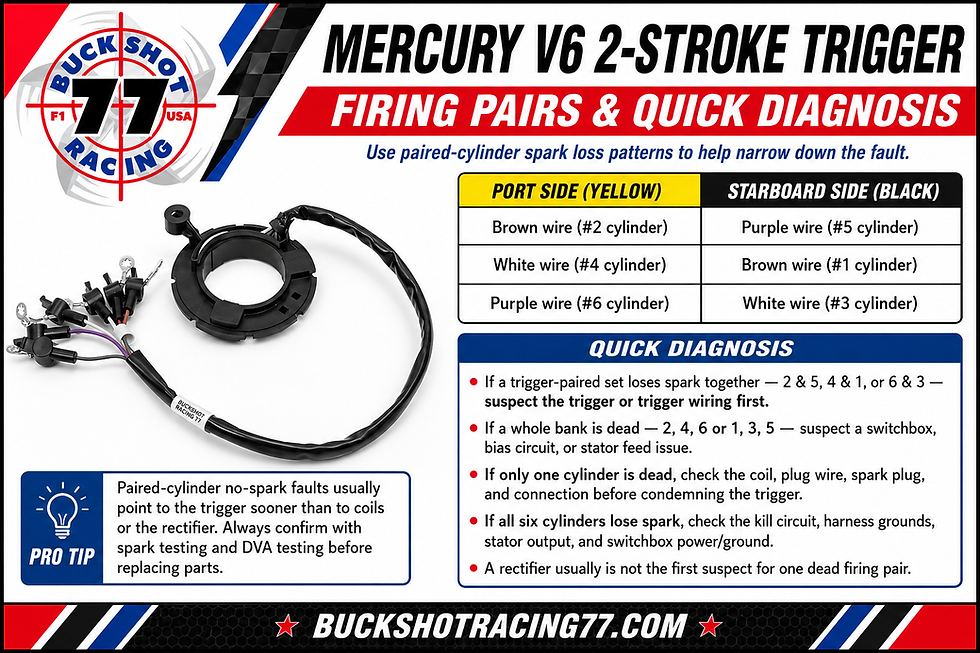
The Mercury V6 2-stroke ignition trigger, commonly searched under 96455A11, 96455A10, 96455A6, 96454, 68162A1, 68162A5, and 68162A8, is one of the most important timing components in the classic Mercury and Mariner V6 ignition system.
Used across many 2.0L, 2.4L, and 2.5L six-cylinder Mercury outboards, this trigger provides the crankshaft-position signal that tells the switch boxes when to fire the ignition coils.
This trigger family is found on many Mercury and Mariner V6 models from the late 1970s through the 1990s, including popular 150 HP, 175 HP, 200 HP, 220 HP, 225 HP, 245 HP, 260 HP, and 300 Drag applications.
Common engine families include Black Max, XR2, XR4, XR6, Magnum III, Laser EFI, XRi, Offshore, Pro Max 200, Pro Max 225, Bridgeport EFI, 245 Carb, 260 EFI, S3000, SST-120, SST-140, 2.5 EFI ROS, and other Mercury Racing carbureted and EFI V6 outboards.
How the Mercury Trigger Works
On Mercury V6 2-stroke engines with ADI/CDI ignition, the trigger works with the flywheel, stator, switch boxes, ignition coils, spark plugs, and engine harness. The trigger assembly contains three pickup coils positioned under the flywheel. As the flywheel rotates, its magnetic poles pass the trigger coils and create timing signals.
Those low-voltage timing signals are sent to the switch boxes, sometimes called power packs. The switch boxes then discharge stored capacitor energy to the ignition coils at the correct crankshaft position.
The coils step up that voltage and fire the spark plugs. When everything is working correctly, all six cylinders fire in precise sequence, giving the engine clean idle quality, strong acceleration, and stable high-RPM operation.
The trigger does not physically touch the flywheel. Its non-contact magnetic design is durable, but age, heat, vibration, cracked insulation, weak wiring, or internal coil failure can still cause ignition problems.
Why Trigger Diagnosis Matters
A failing trigger can create symptoms that look like several other Mercury ignition problems. Rough idle, intermittent misfire, hard starting, sudden RPM loss, weak spark, poor acceleration, or a no-start condition can be caused by the trigger, but they can also come from the stator, switch boxes, coils, spark plugs, plug wires, grounds, kill circuit, or battery cables.
This is where firing-pair diagnosis becomes useful. On many Mercury V6 ADI ignition systems, trigger-related failures often show up as paired-cylinder spark loss rather than one random dead hole. If a paired set loses spark together, such as 2 and 5, 4 and 1, or 6 and 3, the trigger or trigger wiring should move higher on the suspect list.
If an entire bank is dead, such as 2-4-6 or 1-3-5, the problem may be more likely related to a switch box, bias circuit, stator feed, ground, or harness issue. If only one cylinder is dead, always inspect the coil, spark plug, plug wire, coil ground, and connection before condemning the trigger.
That pattern-based approach saves time and prevents unnecessary parts swapping. A rectifier or voltage regulator is usually not the first suspect when one trigger-paired set loses spark, although charging-system faults and poor wiring should still be corrected because they can damage other ignition components over time.
Common Symptoms of a Bad Mercury V6 Trigger
A weak or failing Mercury trigger can cause problems that come and go with heat and vibration. The engine may start cold and then lose spark after warming up.
It may idle unevenly, drop cylinders under load, refuse to accelerate cleanly, or suddenly fall off RPM at speed. Some failures appear as a complete no-spark condition, but many are intermittent enough to make diagnosis frustrating.
The trigger harness should always be inspected closely. Brittle insulation, cracked wire jackets, oil-soaked leads, broken terminals, poor grounds, or wires rubbed through under the flywheel can all interrupt the timing signal. Because these engines are often decades old, the wiring condition is just as important as the trigger coil readings themselves.
Testing and Service Notes
Trigger testing normally begins with a spark test on all six cylinders, followed by resistance checks and DVA output testing according to the correct Mercury factory service manual for the engine. A peak-reading voltmeter or DVA adapter is commonly used because standard digital multimeters often cannot capture ignition pulses accurately.
Before replacing the trigger, inspect the flywheel magnets, stator wiring, switch box grounds, kill circuit, engine harness, and battery cables. A missing or damaged flywheel magnet can disrupt trigger operation, while poor switch box grounds can imitate ignition component failure. After installation, ignition timing must be checked and adjusted to factory specifications before the engine is run hard.
Replacement and Cross References
The most commonly searched current replacement numbers are Mercury 96455A11 and 96455A10. Earlier and superseded references include 96455A6, 96454, 68162A1, 68162A5, and 68162A8. Many aftermarket catalogs also cross-reference this application to CDI Electronics 134-6456.
Because Mercury used several ignition variations across the V6 2-stroke family, always verify fitment by serial number, ignition type, and original harness configuration. This is especially important on performance engines such as 225 Pro Max, 245 Carb, 260 EFI, S3000, SST-120, SST-140, and 300 Drag, where ignition setup and timing accuracy are critical.
Buckshot Racing #77 Tech Tip
Do not diagnose Mercury V6 ignition problems by guessing. Start with a clean spark test across all six cylinders and look for a pattern. Paired-cylinder spark loss usually points toward the trigger or trigger wiring sooner than coils or the rectifier.
A whole-bank failure often points toward switch boxes, stator feed, bias wiring, or grounding. One dead cylinder usually deserves basic coil, plug wire, spark plug, and connection checks first.
The Mercury V6 2-stroke trigger 96455A11 / 96455A10 is a precision timing part, not just another ignition component. When it works correctly, the switch boxes receive clean timing signals and the engine fires every cylinder exactly when it should.
When it fails, even a strong stator and good coils cannot make the engine run correctly. For classic Mercury and Mariner 2.0L, 2.4L, and 2.5L V6 outboards, a properly tested and properly installed trigger is essential for reliable starting, clean acceleration, and dependable high-performance operation.


Comments