


Why Reeds Matter in Mercury 2-Stroke Outboards
.JPG/v1/fill/w_320,h_320/file.jpg)
Updated: Jul 4
On a high-performance 2-stroke outboard, reeds are not just another intake part. They are one of the key components controlling crankcase filling, intake signal, idle quality, throttle response, and overall consistency. At Buckshot Racing 77, we treat reeds like a real performance component because that is exactly what they are.
A reed valve acts as a one-way check valve between the intake side and the crankcase. When crankcase pressure drops, the reeds open and allow the air-fuel charge in. When pressure reverses, they close and keep that charge from pushing back out.
When the reeds seal cleanly and react quickly, the engine starts more easily, idles cleaner, responds more sharply, and carries power more consistently. When they get chipped, curled, cracked, lifted, or simply tired, the engine loses efficiency, and the whole motor starts to feel off.
That is especially true on Mercury and Mercury Racing 2-stroke outboards that see hard use. Reeds are cycling constantly, and on a performance motor, they are opening and closing hundreds of times per second. That makes them a wear item, not something you ignore until a bigger problem shows up.
Why Reeds Matter in a Performance 2-Stroke Outboard
On a stock motor, bad reeds can make the engine feel lazy. On a performance build, they affect the entire combination. Reeds influence how well the crankcase fills, how stable the intake signal stays, and how cleanly the motor transitions from idle to load.
If a reed is not sealing properly, not reacting fast enough, or beginning to flutter, the intake charge becomes less controlled, and the engine starts losing efficiency, which you can actually feel.
That is why the reed system needs to be looked at as a complete package. Petal material matters. Reed design matters. Cage condition matters. Sealing surface flatness matters. Reed stop or rev plate setup matters.
Install quality matters. On a serious Mercury 2.0, 2.4, 2.5, 3.0, 300X, or 3.2 300XS application, reeds are part of the tune-up strategy and part of the reliability strategy.
Common Signs of Failing 2-Stroke Outboard Reeds
A bad set of reeds usually starts showing symptoms before it fully fails. One of the most common is a motor that becomes harder to start and less consistent from one startup to the next. Idle quality usually suffers early. The engine may idle rough, hang unevenly, or feel unstable even when everything else looks close.
Throttle response is another big clue. A motor with weak or damaged reeds often loses that clean, immediate snap it should have when you get back on the throttle. It may still run, but it will feel duller down low and less crisp through transition. On top end, the motor might cause the RPMs to vacillate up and down.
Intake sneezing or coughing is another classic warning sign, especially on carbureted motors. When a 2-stroke starts sneezing back through the intake, that is not something to ignore. A lean idle condition can damage reeds, so replacing the petals without correcting the tune is a good way to ruin a fresh set.
We also look beyond the reeds themselves. A rough idle is not always caused only by the petals.
How Often Should You Replace 2-Stroke Outboard Reeds?
There is no one universal replacement interval because usage matters. A recreational engine that lives an easy life is not the same as a lake racer, drag motor, or hard-running pleasure boat that spends a lot of time at rpm.
At Buckshot Racing 77, we recommend treating reeds like a real service item. On most performance applications, they should be inspected at least once a season, anytime the intake or front half is already apart, and anytime the engine starts showing signs like rough idle, sneezing, lazy response, or inconsistent running quality.
Additionally, it is important to note that stock steel reeds tend to break, and the broken steel shards will damage the internal motor parts. These types of breakages are common over extended years of use and/or higher RPMS over 6,500.
How to Replace 2-Stroke Outboard Reeds the Right Way
A proper 2-stroke outboard reed replacement is not just a quick petal swap. The work around the reed is what determines whether the install actually performs and lasts.
Start by disconnecting the battery, removing the air box, and pulling the carburetors or EFI assembly and intake manifold according to the engine service manual. Tag hoses and wires so everything goes back exactly where it came from. Pay close attention to intake manifold bolt length and location during disassembly, because those bolts need to go back into their original positions.
Once the reed cages are out, inspect everything closely. Old petals, stops, shims, screws, and sealing surfaces all need to be checked. One of the most overlooked steps in a reed install is cage prep. If the cage is not flat, the new reeds will not seal correctly, no matter how good the petals are.
At Buckshot Racing 77, we hand-surface reed cages on a flat plate or a piece of glass, starting with 320 grit and finishing with 600 grit, until the sealing surface is flat and uniform. That is not a shortcut step. That is one of the steps that separates a proper reed job from a parts change.
On dual-stage sets, the primary large reed needs to be installed in the correct orientation, with the taped side against the reed cage. The tape stays in place.
When a rev plate is supplied, it should be used where the application calls for it instead of the stock stop arrangement. We center the reeds carefully, tighten the center screws first, and then work outward so the petals seat evenly.
Fastener control matters too. Reed screws should not be over-tightened. Over-tightening can distort the petal, affect sealing, and cause the reed to lift away from the cage. Reeds should sit with no light gap to the sealing surface.
We torque them to 10 to 12 in-lb, and although we don't use Loctite 242 Blue, go ahead and use some if you are not comfortable with your torque spec.
During reassembly, every gasket should be checked against the old one before it goes on. Some reed and carb gaskets can physically fit the wrong way, and even a small bleed-hole mismatch can create tuning issues immediately. Once the intake is back together, the job is still not finished until the fuel system is momentarily pressurized and checked for leaks.
Best Practices After Reed Installation
Fresh reeds do not fix a bad idle circuit. On carbureted engines, lean sneeze is one of the fastest ways to damage a new set of petals. If the engine is coughing, sneezing, or popping back through the intake, the idle side needs to be corrected.
On Mercury and Mariner WH carburetors that use idle air jets to control idle, the standard correction is to go two sizes smaller on the idle air jets to fatten the mixture slightly.
Engines that meter idle with low-speed fuel jets or idle mixture screws need to be adjusted through those circuits instead. The main point is simple: if the idle side is lean, the reeds may show it.
On fuel-injected engines, there are generally no tuning changes required just because the reeds were replaced, but we still verify the rest of the system before calling the job complete. Reeds are part of a package, not a standalone fix.
Reed Install Instructions, Free PDF Download
Boyesen Dual-Stage Reeds vs Stock Reeds
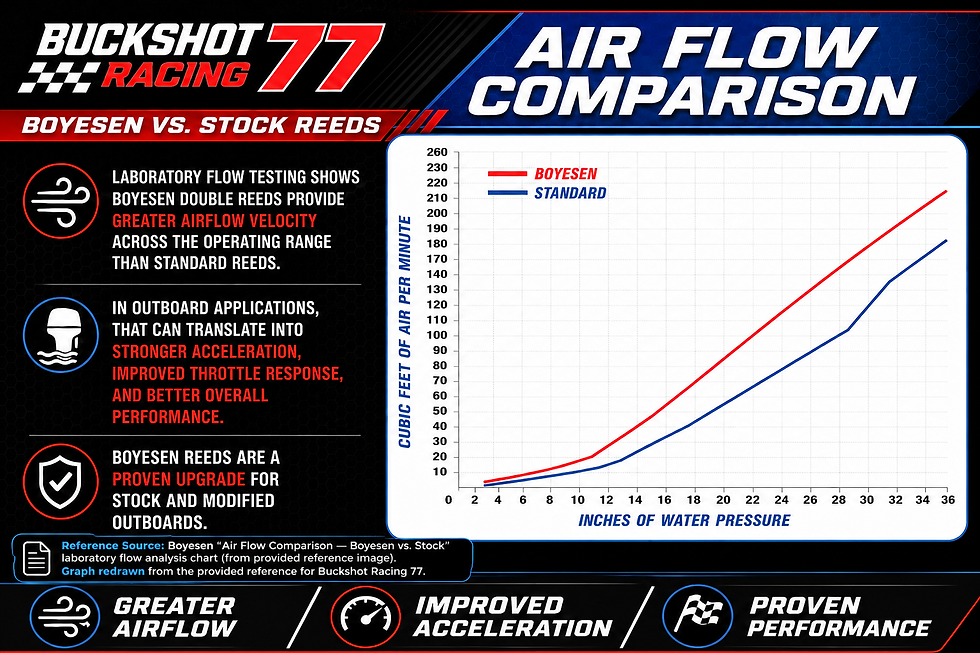
The comparison material lines up with what we see in real Mercury performance applications. The Boyesen dual-stage design carries stronger flow and better velocity across the operating pressure range instead of only working at one narrow point.
That matters because a 2-stroke outboard does not live at one rpm. It moves through startup, idle, throttle transition, acceleration, and sustained load.
That is the real difference between a good dual-stage reed and an average stock replacement. It is not only about a top-end number. It is about how quickly the reed reacts at low pressure differential, how well it controls the charge during transition, and how stable it stays as demand increases.
In the real world, that shows up as cleaner starting, better idle quality, sharper throttle response, stronger acceleration, and a broader usable powerband.
That is why we pay attention not only to the reed design, but also to cage condition, front-half condition, fuel calibration, and install quality. Good parts still need a good foundation around them.
Why Buckshot Racing 77 Recommends Boyesen Reeds
At Buckshot Racing 77, we recommend Boyesen reeds because they work, they last, and they are the reed setup we trust in serious Mercury performance applications. We want a reed that seals correctly, reacts quickly, and stays stable when the motor is actually being used.
For the 2.0, 2.4, 2.5, and 3.0 liter Mercury performance engines, we recommend the Boyesen dual-stage reeds. That two-stage design gives the engine a more responsive reed at lower pressure differential while still supporting airflow demand as rpm and load increase.
In practical terms, the engine feels cleaner, sharper, and more responsive through a wider operating range.
For the 2.5 Sportjet Cage and the 300X and 3.2 liter 300XS, we recommend the Boyesen single-stage carbon reeds. Those five-petal 3.0 and 3.2 liter applications are a different cage and airflow package, and the single-stage carbon setup is the right match for those engines.
We've learned to match the reed to the engine family and the way that engine actually runs.
The Bottom Line on 2-Stroke Outboard Reeds
If you want a 2-stroke Mercury outboard to run the way it should, reeds need to be part of the conversation. They directly affect crankcase fill, intake signal, idle quality, throttle response, and consistency from the hit to the top end.
Inspect them regularly. Prep the cages correctly. Install them correctly. Tune the idle side correctly. And use the right reed design for the engine you are building.
That is why Buckshot Racing 77 recommends Boyesen reeds for serious Mercury and Mercury Racing applications: dual-stage for the 2.0, 2.4, 2.5, and 3.0 liter engines, and single-stage carbon for the 300X and 3.2 liter 300XS.
Shop the Reeds We Run
If you are rebuilding or freshening a Mercury performance outboard, choose the reed package that matches the engine.
For 2.0, 2.4, 2.5, and 3.0 liter applications, run the Boyesen dual-stage reeds for broader response, stronger acceleration, and proven performance.
For 300X and 3.2 liter 300XS applications, run the Boyesen single-stage carbon reeds for the correct five-petal setup and stable high-performance control.
If your outboard is getting harder to start, idling rough, sneezing through the intake, or losing that crisp clean response it used to have, and or vacillating on top end, it is time to inspect the reeds and install the right set.


Comments