


Prop Slip Calculator, High-Performance Boating
.JPG/v1/fill/w_320,h_320/file.jpg)
Updated: Sep 28

Prop slip is one of the fastest ways to turn a GPS speed number into a useful boat setup decision.
Whether you run a Mercury Racing outboard, F1 tunnel boat, bass boat, offshore vee-bottom, center console, cat, drag boat, lake boat, river boat, or high-performance fishing boat, the Buckshot Racing #77 Prop Slip Calculator helps you understand how your propeller pitch, gear ratio, engine RPM, GPS speed, engine height, trim, and boat load are working together.
Prop slip is not a trophy number. It is a setup tool. A lower number is not always better, and a higher number is not always wrong. The right slip number depends on the boat, propeller style, gearcase height, load, water conditions, and how the hull carries itself at speed.
Start Here: Which Calculator Tab Should You Use?
Use the Propeller Slip tab when you already have a real test pass. This tab tells you what your current setup is doing. Enter your prop pitch, gear ratio, engine RPM and GPS speed. The calculator will show your prop RPM, theoretical speed and prop slip percentage.
Use the Theoretical Setup tab when you want to compare possible changes before swapping parts. This tab is for “what-if” setup work. Use it to compare a different prop pitch, RPM target, gear ratio, or expected speed based on a known slip number.
The Best Prop Slip Calculator Tool (Free Below)
Step 1: Make a Clean GPS Pass
Before using the calculator, make one clean wide-open-throttle pass with the boat fully warmed up and running normally. Record the GPS speed and RPM from the same pass. Do not use RPM from one run and GPS speed from another run.
For the best data, test in calm water, avoid heavy current, and make one pass in each direction. If possible, average the GPS speed from both directions. Record fuel load, passenger load, trim setting, jack plate height, propeller pitch, and gear ratio.
A good slip number starts with good data. If the input numbers are wrong, the calculator result will be wrong.
Step 2: Use the Propeller Slip Tab
Open the Propeller Slip tab and enter four numbers.
Enter the propeller pitch stamped on the prop. If the prop has heavy cup, blade work, or a lab finish, remember that it may act like more pitch than the number stamped on the hub.
Enter the gear ratio as a simple number, such as 1.62, 1.75, 1.87, or 2.00. Do not enter it as “1.75:1.” Gear ratio matters because the propeller turns slower than the engine crankshaft.
Enter the engine RPM from a reliable tachometer. A tach that is off by a few percent can change the slip number enough to send you in the wrong direction.
Enter the GPS speed from the same run. Use GPS, not a dash speedometer, pitot tube, or paddle-wheel speed reading.
After you enter the numbers, the calculator will show your prop RPM, theoretical speed and slip percentage. This is your baseline.
Step 3: Understand the Slip Number
Prop slip is the difference between the theoretical speed the propeller should run and the actual speed the boat runs on GPS. Every propeller needs some slip to create thrust. Zero slip is not realistic, and negative slip usually means the data needs to be checked.
For many high-performance outboard boats, 5% to 10% slip is a strong range. Some very efficient race boats, drag boats and light cats may run lower.
Offshore boats, center consoles and heavier loaded boats may run higher.
Some F1 tunnel boats, surface-running cleaver setups and high engine-height race applications may show higher calculated slip because the propeller is running high, partially surfaced, or in aerated water.
That is why prop slip should always be judged by application. A bass boat, Sport Master tunnel boat, F1 hull, offshore vee-bottom, pontoon, drag boat and center console should not all be judged by the same target number.
Step 4: Go to the Theoretical Setup Tab
After you calculate your current slip, go to the Theoretical Setup tab. This is where the calculator becomes a setup planning tool.
Use your real slip number as the target slip. For example, if your current setup calculates at 6.5% slip, enter 6.5% into the Theoretical Setup tab.
Then change pitch, RPM, or gear ratio to compare possible setups.
This tab helps answer real-world setup questions before you start swapping parts. It can help you estimate whether a 26-pitch prop may be faster than a 24-pitch prop after the expected RPM drop.
It can help show whether a gear ratio change will require a different prop. It can help you decide what propeller to bring to the lake, race site, or test session.
The Theoretical Setup tab does not guarantee the boat will run that exact speed. It assumes the new setup can hold the same slip.
If the new prop ventilates, loads the engine too hard, carries the hull differently, loses water pressure, or changes handling, the actual GPS speed may be different. Use this tab as a smart planning guide, not a promise.
Typical Prop Slip Ranges
Use these ranges as general guides, not hard rules. Hull design, load, water conditions, propeller type, engine height, trim and setback all affect slip.
Boat Type / Application | Typical WOT Slip Range | How to Read It |
Light race boat, drag boat, efficient cat | 2%–6% | Very hooked up; data must be accurate |
Bass boat or lake performance boat | 5%–10% | Strong all-around performance range |
Ski boat or family performance setup | 6%–12% | Good balance of acceleration and speed |
Offshore vee-bottom, center console, sportfish | 8%–15% | Load, wind and sea conditions matter |
Pontoon, work boat, heavy loaded hull | 12%–18% | Higher slip can be normal under load |
F1 tunnel, surface-running prop, high engine-height race setup | 12%–25% | Can be normal when the prop is high, surfaced, or aerated |
Over 20% on a normal submerged-prop setup | Investigate | Possible ventilation, wrong pitch, height, load, or blade issue |
A 20% slip number may be a problem on a normal submerged-prop bass boat. That same number may be acceptable on an F1 tunnel boat or surface-running race setup if the boat is fast, stable, carrying correctly, maintaining water pressure and turning the correct RPM.
Why Some Fast Boats Show Higher Slip
Some high-performance boats run the gearcase high to reduce drag. Some use cleavers, choppers, semi-surfacing propellers, or lab-finished wheels. Some hulls carry more of the boat on air or lift instead of pushing the full hull through the water.
In those setups, the propeller may not be fully buried. It may be running partially surfaced or in aerated water. The calculated slip number can look higher even when the boat is running correctly.
This is common in certain tunnel hull, cat, F1, drag and race applications. It can also show up on high engine-height lake boats and light performance hulls. The correct question is not “Is the slip number low?”
The correct question is “Is the boat faster, safer, stable, in the RPM range and carrying correctly?”
What Negative Slip Means
If the calculator shows negative slip, check the data. The boat is not more than 100% efficient.
Negative slip usually means the gear ratio is wrong, the tach is inaccurate, the GPS number is wrong, the pitch was entered incorrectly, or the propeller has more effective pitch than the stamp shows. Cup, rake, lab finishing and blade work can make a propeller act taller.
If you are running a heavily cupped or worked propeller and the slip number looks too low or negative, try adding half an inch or one inch of effective pitch in the calculator and see if the number makes more sense.
How to Use the Results
If slip is high, RPM is high and speed is low, the propeller may not be holding water. The setup may need more cup, more blade area, a lower engine height, less positive trim, or a different propeller style.
If slip is high and RPM is low, the engine may be overloaded. The boat may need less pitch, less load, a different propeller, or a closer look at gearcase drag and blade condition.
If slip is acceptable but RPM is too high, the engine may be able to pull more pitch. Go to the Theoretical Setup tab and compare the next pitch before testing.
If slip is acceptable but RPM is too low, the boat may be over-propped. Use the Theoretical Setup tab to compare less pitch and see how the speed estimate changes when RPM comes back into the powerband.
If hole shot is poor but wide-open slip looks good, remember that WOT slip does not describe launch. Blade count, diameter, rake, cup, ventilation and engine height all affect the first 50 feet.
What to Change First
Start with pitch. More pitch usually lowers RPM and may add speed if the engine can pull it. Less pitch usually raises RPM and can improve acceleration.
Cup adds bite and often increases effective pitch. A propeller with more cup may reduce slip without changing the stamped pitch number.
Diameter and blade area help carry load. Heavier boats, offshore boats, loaded fishing boats and rough-water setups may need more blade area.
Engine height changes how much gearcase and propeller are in the water.
Raising the engine can reduce drag and improve speed, but it can also increase slip if the propeller starts to ventilate. Lowering the engine can improve bite and water pressure but may add drag.
Trim changes hull attitude. A little positive trim can free up the hull. Too much trim can raise slip, blow out the propeller and make the boat unstable.
Gear ratio changes prop shaft RPM. After any gearcase swap, go back to the calculator before blaming the propeller.
Best Testing Method
Make one baseline run and record pitch, gear ratio, RPM, GPS speed, engine height, trim, fuel load and passenger load.
Use the Propeller Slip tab to calculate your current slip.
Use the Theoretical Setup tab to compare the next pitch, gear ratio, or RPM target before changing parts.
Make only one change at a time. Do not change pitch, trim, jack plate height and load all at once.
Run the same course again, preferably in both directions, and average the GPS speed.
Keep the change only if the boat gains speed, keeps safe water pressure, stays stable, and keeps the engine in the correct RPM range.
Common Mistakes
The most common mistake is using bad data. Do not use the dash speedometer instead of GPS. Do not guess the gear ratio. Do not mix GPS speed from one pass with RPM from another. Do not compare a light-fuel solo pass to a full-load run and expect the same slip.
Another mistake is chasing the lowest slip number instead of the fastest, safest setup. A boat can show a pretty slip number and still be slower because the engine is out of its powerband or the hull is not carrying correctly.
A third mistake is ignoring the Theoretical Setup tab. That tab can save time, fuel and prop swaps by showing whether a pitch or gear ratio change makes sense before you test it.
Bottom Line
The Buckshot Racing #77 Prop Slip Calculator is a setup tool for Mercury outboards, Mercury Racing engines, F1 tunnel boats, bass boats, offshore boats, cats, drag boats, lake boats, river boats, and high-performance marine setups.
Start with the Propeller Slip tab to calculate your real-world slip from an actual GPS run. Then use the Theoretical Setup tab to compare the next propeller, gear ratio, RPM target, or setup change before testing.
The goal is not the lowest slip number. The goal is the best honest setup: correct RPM, safe water pressure, stable handling, strong acceleration, and the best real GPS speed for your boat.
By routinely using a prop slip calculator, racers can refine their setup for maximum speed, better fuel efficiency, and enhanced handling, ultimately leading to better results on the water.


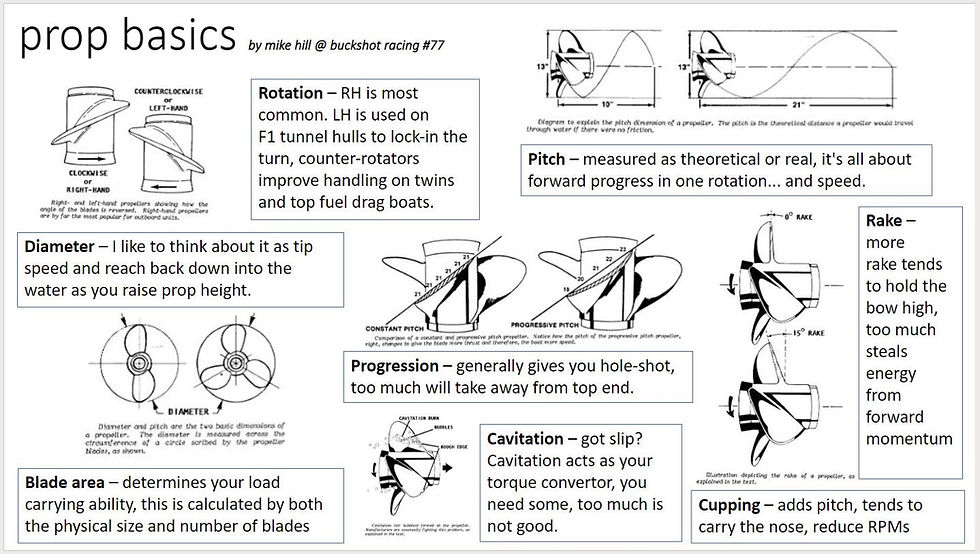
Pretty accurate for theory